What is Engineering Validation?
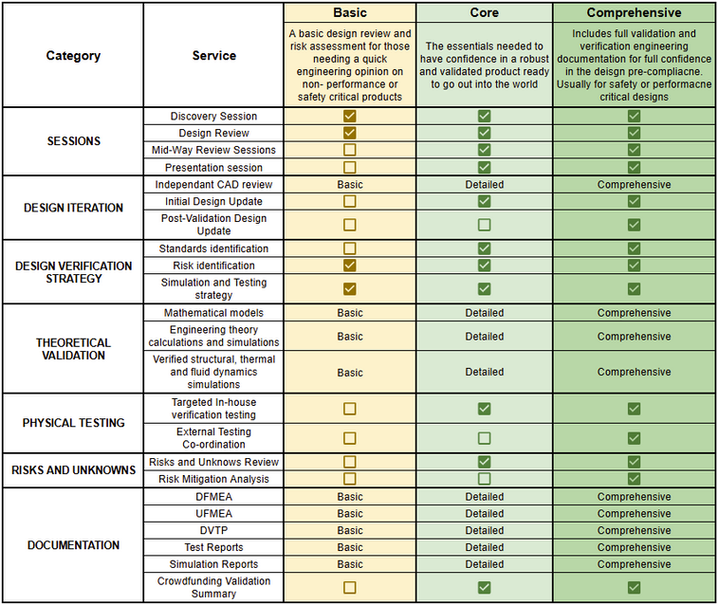
Engineering validation services are also tiered in order to accommodate various project needs from simple products that have few performance and safety requirements, to complex, safety-critical products using novel technology that need in depth validation along with part optimisation.
When moving towards manufacture, a thorough understanding of the products capabilities, risks and performance is critical. Compliance fails can be costly, and finding requirement failures in a product half-way through mass production is a disaster in terms of financial resources and time spent to rectify.
Engineering Validation aims to verify that your product meets all requirements before committing to tooling. I use various tools to achieve this including computer aided simulation, mathematical modelling and engineering theory analysis, physical testing and user testing. These tools are used within a strategy devised early in the service which is formulated from a review of the requirements and regulatory landscape of the product.
To build confidence, proper User Failure Mode and Effects Analysis and Design Failure Mode and Effects Analysis is included along with a robust and structured design verification plan. Finding failures early and having a plan to save them reaps huge rewards in terms of time and money saved during a product development process.
Engineering validation is also about part optimisation, finding where parts are over-engineered and can be simplified or reduced in cost whilst still meeting the requirements.
Each validation strategy is tailored to the specifics of your product while, as usual, following a consistent engineering framework. Please get in touch to find out more, I'd love to hear about your specific product needs.
What Does Engineering Validation Involve?


What Are The Objective Outputs?
The subjective goal of engineering validation is to build confidence that your product will stand up to its requirements in the real world. We want to find potential failures either user failures or design failures and eliminate their likelihood. We also want to ensure that the performance matches the requirements set-out. The best way to build this confidence is by coming up with a structured and robust strategy to verify the product and then carrying it out rigorously.
Translated into objective outputs this might include some or all of the following:
-
An Initial design review to catch any immediate issues
-
Requirements and regulatory landscape review report
-
Pre-validation risk assessments (DFMEA and UFMEA)
-
A design verification and test strategy document
-
Mathematical Modelling reports and any files created such as coding scripts
-
Simulation analysis and results reports
-
Design optimised CAD files
-
Physical and User Testing Reports
-
External Testing co-ordination and results analysis
-
Post-analysis design update
-
Updated risk assessments
Detail-Designed Product
Engineering Validation
- Theoretical validation of design performance
-Optimised Design
- Failure assessment and mitigation
- Investor Ready Reports
Which Tier is Right for Me?
Basic
Best for products without high-performance or safety critical requirements with a focus instead on ensuring a robust, use-able and quality designed products.
Perfect for Entrepreneurs or founders without engineering expertise but maybe product design experience looking for a basic assessment and verification of their design from an engineering point of view.
Core
Great for small teams that don't have dedicated engineering resource needing all of the essential documentation for product validation as well as high confidence in design performance as well as optimisation and part efficiency
Also a good fit for any company needing more resource to validate an already designed concept.
Comprehensive
Best for more established companies needing a technically rigorous and strategic analysis of a designs performance, safety and efficiency. Perfect for products with high performance or safety requirements.
Also ideal for single Entrepreneurs needing comprehensive product validation support and need confidence in the verification of their design before committing hundreds of thousands of pounds into tooling.
Cost and Timeline
I like to be transparent about the work I do for accountability and for building great relationships with partners. Get in touch and I'd love to have a chat about timeline and pricing quotations for your specific product. I quote by estimating a timeline of engineering hours needed for the service and apply an hourly rate.
Services Timeline
Below is a typical timeline of where each stand-alone service typically falls in the product development process. If you choose to go through the whole product development process with me, the services are far more integrated and iterative meaning that design verification and design for manufacturing considerations are baked into the detailed design and prototyping phases.
This reduces duplicated work in scope overlap and ensures smooth knowledge transfer throughout the process as well as a more natural, although still structured, development process.
Click on the buttons below to explore the Product Development service and find out more about how it works. Alternatively, if you know you need a specific stand-alone service, click the individual service buttons below to find out more
(All Services Integrated)